
In The Boy with White Skin, Simon Panay delivers an arresting and deeply human portrait of life in the gold mines of West Africa, where myth, survival, and sacrifice converge in haunting harmony. This OSCAR-qualified live-action short is not just a film, it’s a cinematic rite of passage that echoes long after the final frame.
This OSCAR-qualified live-action short is not just a film, it’s a cinematic rite of passage that echoes long after the final frame.
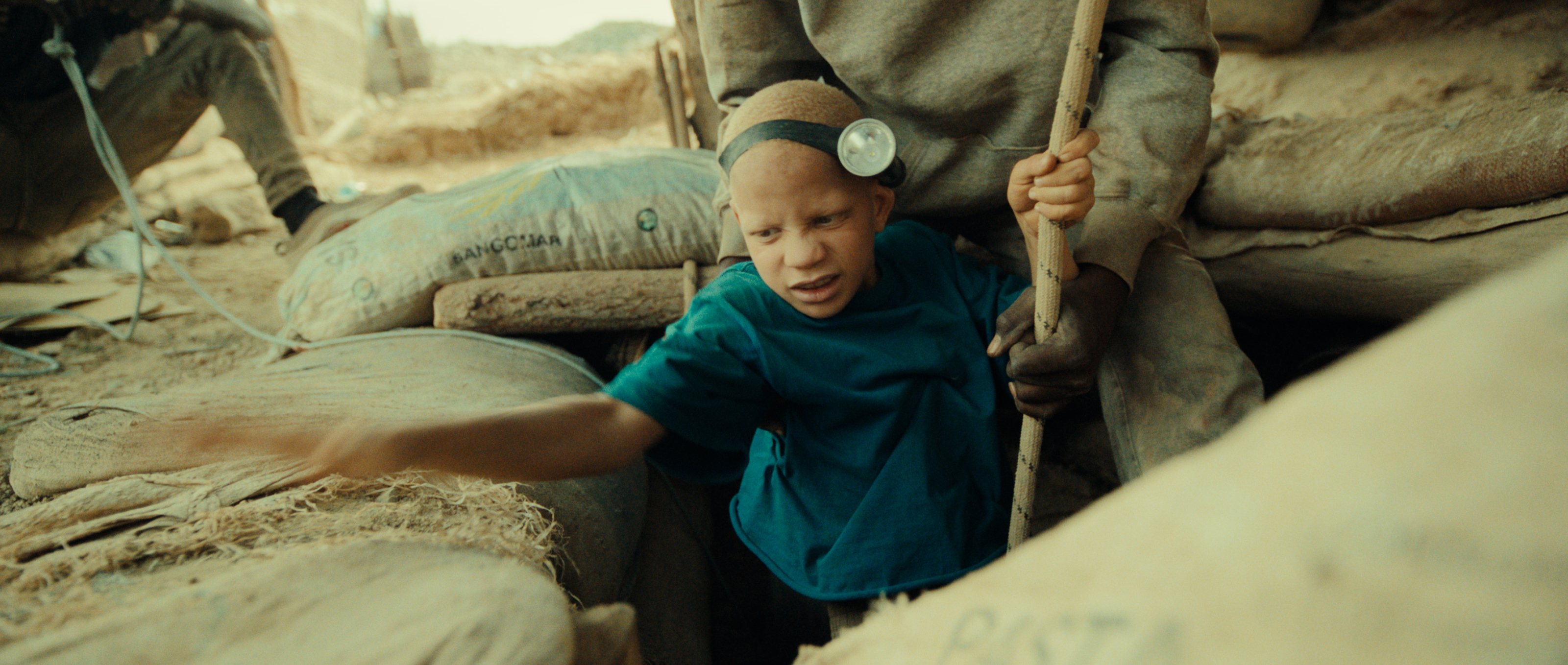
Set within the suffocating depths of an artisanal gold mine, Panay’s 24-minute short introduces us to a young albino boy whose voice is believed to hold mystical power. Entrusted to miners by his father, the child becomes a spiritual conduit, a symbol of protection in a space where death is a daily companion. In this world, albino children are revered, feared, and mythologized. The boy’s haunting songs are more than mere ritual, they’re an offering, a lifeline, a tether to a belief system that shields against the void.

Panay’s storytelling is simultaneously grounded and poetic, blending ethnographic realism with a lyrical, almost dreamlike visual style. It’s no surprise, this film is the culmination of over a decade of research and immersion. Inspired by a real-life ritual Panay was never permitted to film, The Boy with White Skin becomes both a reconstruction and a reverie—a cinematic translation of what lies just beyond the camera’s reach.
Panay’s storytelling is simultaneously grounded and poetic, blending ethnographic realism with a lyrical, almost dreamlike visual style
The film’s cinematography is breathtaking, capturing the claustrophobic tension of the underground with a painter’s eye for light and shadow. Every frame is alive with detail, from the sweat-drenched bodies of the miners to the flickering lamps cutting through darkness, to the quiet gaze of the albino boy whose silence speaks volumes. The sound design, too, is evocative, weaving together the metallic rhythm of tools, the deep earth groans of the mine, and the ethereal cadence of the boy’s voice.
What makes The Boy with White Skin so exceptional, however, is its moral complexity. It doesn’t offer judgment, nor does it romanticize hardship. Instead, it gives us access to a cultural space often distorted by outside eyes. It respects its subjects—miners, fathers, children—as both individuals and as part of something larger: a fragile ecosystem of tradition, desperation, and belief.
What makes The Boy with White Skin so exceptional, however, is its moral complexity.
The film is also a triumph of cross-cultural collaboration, brought to life by Senegal’s Astou Production and France’s Bandini Films. Their partnership yields a story that is both rooted in local realities and elevated by international craft. With over 40 official selections worldwide and a growing list of major awards, including the France Télévisions Grand Prize at Clermont-Ferrand and Oscar-qualifying wins at Balinale and Rhode Island—the film is rapidly solidifying its place as one of the year’s most talked-about shorts.
Panay describes gold as “a Beast… one that must be hunted, tracked, and confronted.” In The Boy with White Skin, that beast takes many forms—greed, tradition, myth, and hope. The film dares us to confront them all.
Margaret Brown