What inspired the concepts behind THE SENTRY?
I’ve always loved action and spy movies—James Bond, that whole world. But I’ve also been disturbed by how casually those films treat violence. There’s this tendency to show people getting killed left and right, without acknowledging their humanity. Over time, I think that kind of storytelling can be corrosive—it numbs us. So I wanted to flip the perspective and tell a story that humanizes one of those faceless, throwaway henchmen we usually don’t think twice about.
Also, I live and work in Cambodia, where ghost stories are a big part of the culture. So the idea of a dead man with unfinished business—that really resonated. The two ideas just clicked.
The film plays with familiar spy movie tropes but subverts them in surprising ways. What did you want to challenge or reveal about the genre?
I wanted to take the playful, insouciant tone that spy movies often have—the slickness, the lone-wolf hero who takes out enemies with a smirk—and flip it on its head. These stories often gloss over the human cost of the violence they depict. By simply shifting the camera to focus on one of those “expendable” characters, the whole tone changes. Suddenly, it’s not just a game anymore. You start to see the emotional and ethical weight of what’s usually brushed off as entertainment.
How did you approach the character of the sentry? What does he represent in the larger context of the story?
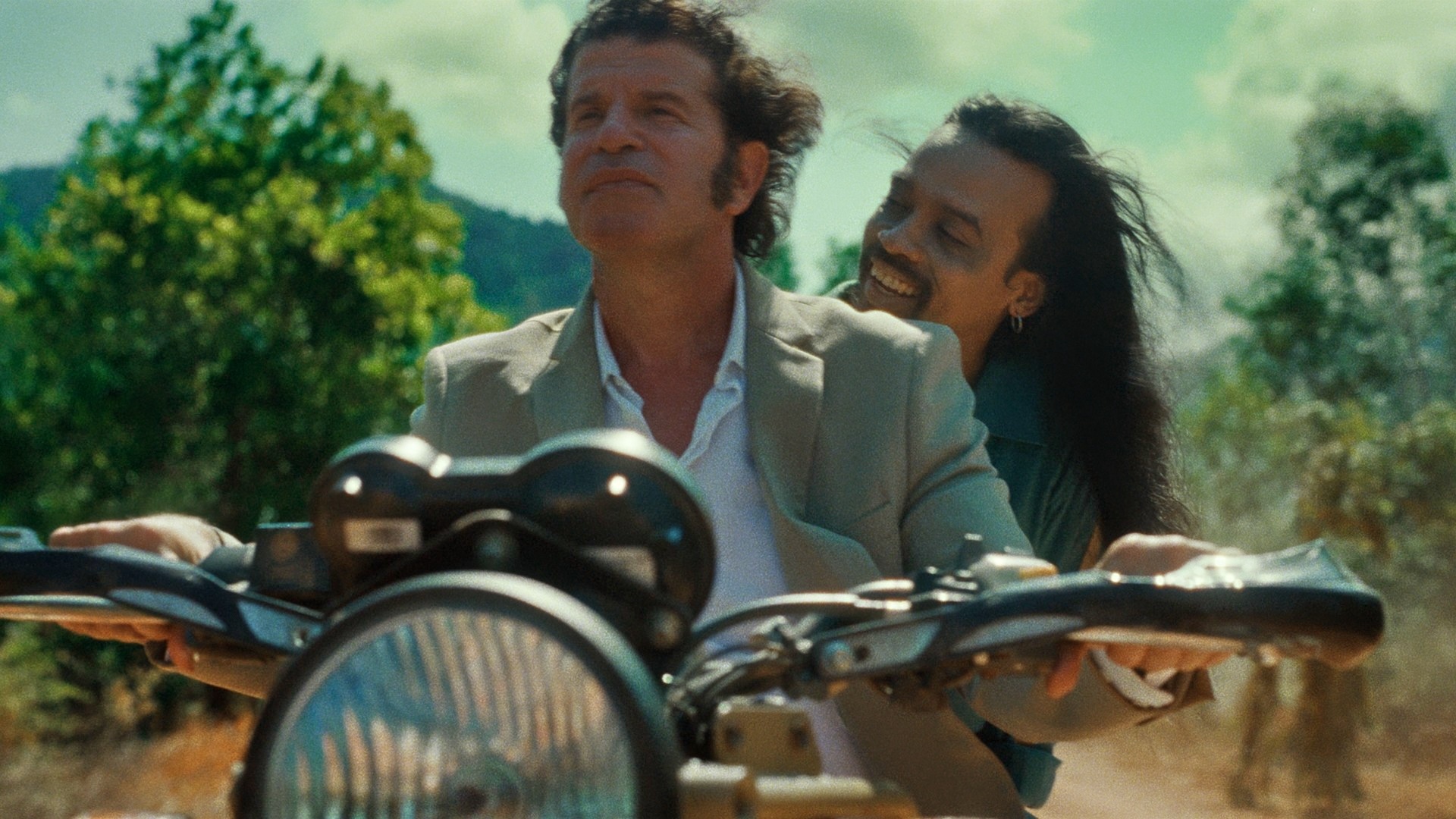
I wanted the sentry to feel like one of those countless background characters we see in action movies—the ones who are usually there just to get knocked out or shot. At first, he comes off kind of annoying—a jokester, always talking. But gradually, you realize that the reason he keeps telling stories is because he _lives_ for storytelling. It’s how he processes the world, how he holds on to his family, his memories, his identity. And it turns out, he’s actually a great storyteller.
So he represents that “other” we’re so quick to dismiss—the nameless henchman, the disposable character. But when you take a closer look, he’s fully human, with a rich emotional life. That’s what I wanted to explore.

THE SENTRY suggests deeper moral and political undercurrents beneath its comedic tone. How do you balance humor with serious themes without losing either?
It’s great to hear that the balance comes through—because it’s definitely a risk. This was my first time trying to weave humor and serious themes together in this way. But I think the comedy actually helps make the deeper stuff land. The
humor disarms you; it draws you in. Then, once you’re engaged, the emotional and political layers can hit with more impact.
At the same time, I’m drawn to genre—I want to entertain. I think art is most interesting when it can’t be pinned down to one tone or category. So for me, the challenge—and the joy—was in making something that moves between those registers without losing its integrity.
You’ve lived and worked in Cambodia for years. How has your experience there influenced your storytelling?
I’ve always been drawn to cinema as an empathy machine—its ability to collapse the distance between a viewer and someone whose life might otherwise feel worlds away. Travel can do that too, but living in another culture deepens it even more. It’s all part of the same mission: to understand others, to connect.
Living in Cambodia has shaped the kinds of stories I want to tell. There’s a particular depth to the way family and community function in Cambodian life, and that’s had a big influence on my work. And being outside the American bubble gives me more freedom to explore strange, unconventional ideas that don’t have to fit into familiar formulas.
The film critiques the Western savior complex in subtle ways. How do you navigate telling stories that involve Western characters in non-Western settings without falling into the same traps you critique?
This is such an important question—and honestly, something I wrestle with constantly. I’m not sure it’s possible to avoid those traps entirely, but I try to be conscious and intentional. A big part of that is turning the camera back on myself—on the culture I come from, the systems I’m implicated in. THE SENTRY is about neocolonialism, and so
was my first feature, KARMALINK. Even though they center Cambodian characters, in some ways, they’re also autobiographical.
It’s also essential to me that these films are made in close collaboration with Cambodian artists. My producer, Sothea Ines Sol, is a key part of the country’s cultural renaissance. The rest of the crew is about 80-90% Cambodian. That collaboration isn’t just about authenticity—it’s about respect, accountability, and building something together.
How did Cambodian collaborators influence the tone or authenticity of the film? Did any particular moment or feedback during production shift your perspective?
Absolutely. I’m incredibly lucky to have worked with people like our stunt coordinator, Pong, and his team, who are trained in Bokator, Cambodia’s traditional martial art. Their expertise deeply shaped how we approached the fight choreography.
There are so many specific touches that came directly from my collaborators—things I never would have thought of. For instance, the sister-in-law character weaving lotus flowers, or the foods in the feast scenes. Even small turns of phrase in the dialogue. These details breathe life into the world and make it richly Khmer. My collaborators weren’t just helping—they were co-creating the world of the film.
What were some of the biggest challenges in making THE SENTRY, logistically, creatively, or emotionally?
One of the biggest logistical challenges was building a set on top of Bokor Mountain in southern Cambodia. It took a long time to get official permission to shoot there—we had to go through the government, which added a layer of complexity.
So as we approached production, we actually had two parallel plans: one to shoot at Bokor, and one to build an alternate lair set inside a cave. That would have required redesigning the entire fight sequence, production design, and cinematography. Keeping both options viable took a lot of flexibility, creativity, and nerve.

The film has a very polished visual style. How did you approach the cinematography and overall look of the film?
My DP, Karl-Erik Brøndbo, and I had a strong collaboration. He’s Norwegian, has shot all over the world, and brought a lot of experience with action and fight sequences. We wanted the visual style to evolve with the story. It starts off slick, like a traditional spy movie, but gradually shifts into something more pared-back and intimate, almost like a road movie. That shift reflects the emotional journey of the characters.
And at the same time, the film is a love letter to Cambodia. We put a lot of energy into the aerial cinematography and capturing the natural beauty of the landscape. The film is steeped in place.
Was the short always intended to stand alone, or could it be part of a larger project or series?
I’m currently developing a feature version, which has been really fun. It expands the world in both directions. We learn more about the spy’s mission, the agency he works for, and the other agents, but we also go deeper into the sentry’s backstory. The feature opens up both comedic and dramatic possibilities—it keeps the same tone of tonal tightrope-walking, but on a bigger scale.
THE SENTRY has screened at top-tier festivals like SXSW and Raindance. What kind of response has surprised you most from audiences?
I’ve been really moved by how many people have told me the ending made them cry. That’s incredibly meaningful to me. I think there’s often a pressure to be ironic or cool in genre filmmaking—but I wanted to go in the other direction. I wanted to risk being sentimental, to put real
feeling on the screen.
That kind of emotional sincerity might not be fashionable, but I think it’s the coolest thing there is. And to see it resonate with audiences around the world—that’s the best reward.
With audiences around the world watching, what do you hope viewers take away from this story especially those unfamiliar with Cambodia or its context?
I hope it makes people think twice—not just about the casual violence in movies, but about the anonymity that global capitalism imposes on so many people doing the world’s hardest work. The sentry could just as easily be a factory worker or a security guard—someone whose humanity is too often overlooked.
And I hope viewers come away with a sense of warmth toward Cambodia. I’ve lived there for ten years, and I’ve fallen in love with the country. If the film can spark even a little bit of that feeling in someone else, that means a lot to me.
Your debut feature, KARMALINK, also blended genre with local storytelling. How do you see your work evolving from here?
I love working in genre—it gives you a lot of tools to explore big ideas in unexpected ways. I’m especially drawn to science fiction and to stories about the climate crisis. There’s a lot I’m developing in that space.
At the same time, I’m glad to have made THE SENTRY, an action film that lets me play with a different set of genre conventions. Across all of it, though, I want to keep telling stories that carry a political message, that subvert or interrogate the narratives we take for granted. I want the work to surprise people—and to have real heart.
Finally, what stories, untold or overlooked, do you feel most compelled to bring to the screen next?
In addition to developing the feature version of THE SENTRY, I’m working on a solar punk sci-fi project called LAKE OF STARS. Solar punk is a genre that imagines a more equitable and sustainable future—one where technology is used to protect the planet, not exploit it. In this story, the Global South is at the forefront of that shift, leading the way in sustainable innovation.
At its core, the film is about the tension between staying on Earth to do the vital work of healing and rebuilding, versus the intoxicating lure of exploration and discovery in space. And honestly—I think seeing Cambodians in space would be pretty cool.