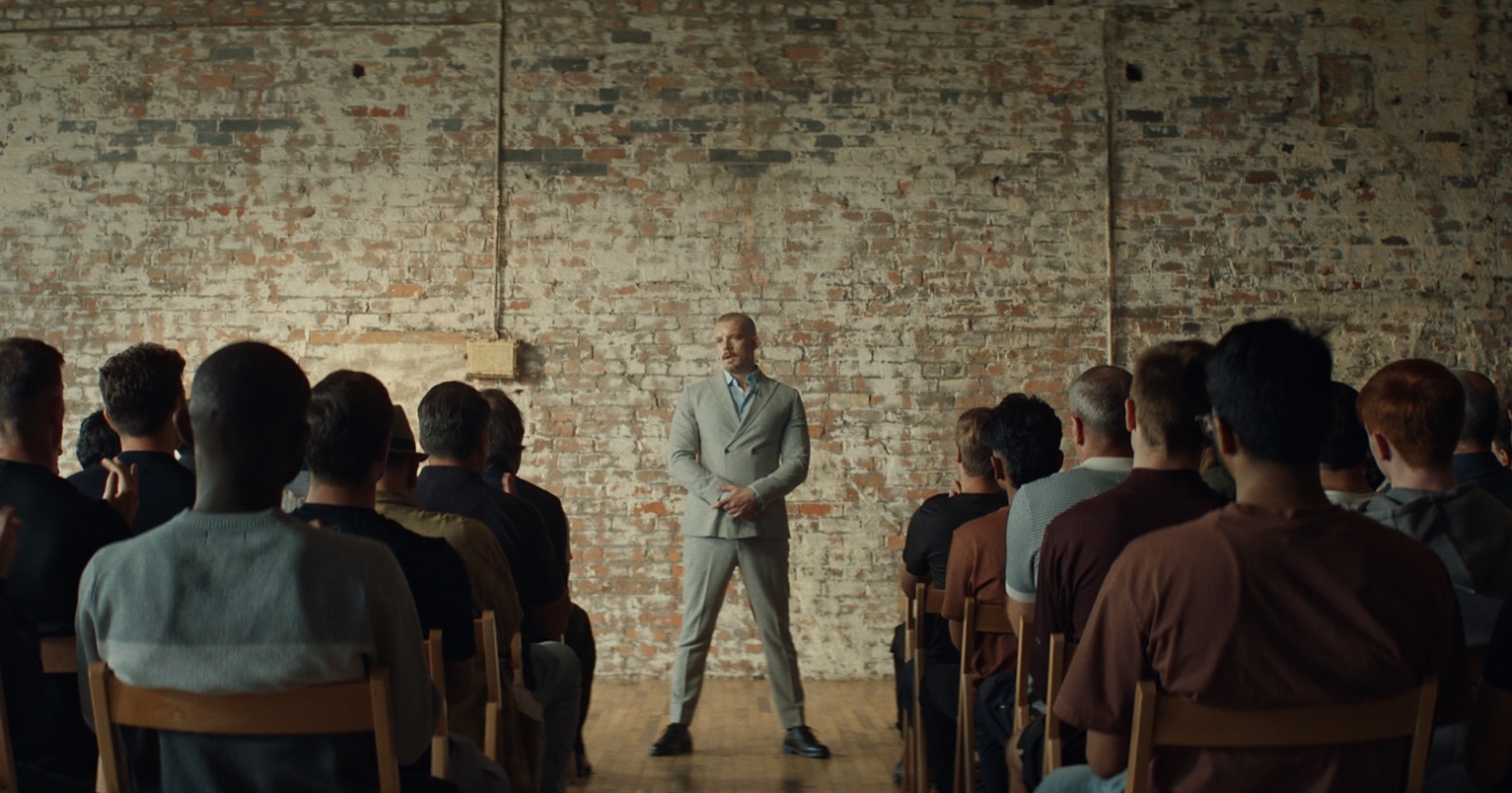
Sai Karan Talwar’s I Am the Prize takes a sharp look at the performance of masculinity and what happens when that performance begins to crack. The film opens with an impressive long take of Anthony Selvon (Russell Tovey), a successful motivational speaker addressing a room full of young, impressionable men about confidence, women and the importance of believing that you are “the prize.” That carefully constructed facade begins to unravel when a journalist confronts Anthony about his private life, revealing aspects of his true self that he has kept hidden from his many followers.
Russell Tovey gives a powerful, finely controlled performance. With masculinity and the “manosphere” becoming increasingly prominent topics of conversation, there are moments where Anthony feels uncomfortably reminiscent of public figures we can recognise in the real world. Tovey captures both the arrogance of someone completely convinced by his own persona and the duplicity that lies underneath it. He isn’t simply presented as a villain, but also as a gateway to examine why someone may becomes invested in displaying a certain version on masculinity that leaves no room for weakness.
Masculinity has been a subject that has been explored from various angles in recent years, from the superb Netflix series Adolescence and Louis Theroux’s Inside the Manosphere to Jon Ronson’s recent non-fiction book The Castle. I Am the Prize adds something of its own to that conversation, by examining the performative element of these “male influences”, their confidence, bravado and carefully constructed image that can conceal something far more complicated underneath. The film effectively exposes the disconnect between public persona and private life, while suggesting that some figures are willing to exploit the crisis in masculinity for their own gain without necessarily believing in the doctrine they sell.
I Am the Prize is a timely exploration of how easily charisma can be mistaken for truth, particularly in an age where confidence can be packaged, performed and sold online. Talwar’s film understands that the most dangerous ideas are not always delivered by people who seem dangerous, but by those who know exactly how to command a room. It is a biting look at the culture wars, the crisis in masculinity and the growing industry built around telling insecure young men exactly what they want to hear without helping them at all.
Britan Cotter